


Wind turbine installation
We develop lift plans and select suitable cranes for WTG installation. Installation follows OEM requirements and international and local standards.
A wind turbine converts kinetic energy of wind into electricity. It comprises structure, machinery, control, and safety systems. Main components:
Installation can be grouped into three phases:
Preparation includes WTG unloading and crane pad / access preparation. Unloading may occur before foundation works or after foundation pour; laydown must match the lift sequence. If civil works have not started, components must be stored without blocking earthworks and must remain reachable for later lifts.
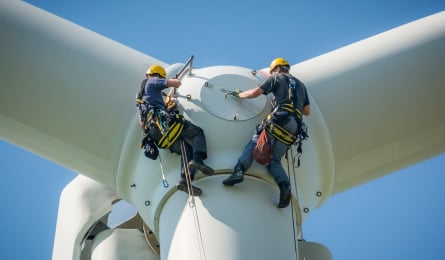
Sound unloading plans and construction schedules reduce crane time and extra component moves.

High-strength concrete may not be available from every plant; large pours must be continuous and coordinated.
Quality depends on logistics and experienced contractors.


The nacelle is completed on the ground per OEM instructions, joints are sealed against moisture, then the assembly is lifted onto the tower.
Typical schemes:
We install WTGs across Belarus, Kazakhstan, and Russia. Call +375 (29) 747-07-09 (+7 (967) 351-67-68), email info@ecotek.pro, or use the contact form.
Roughly: foundation civil works (often 2–3 weeks), concrete curing (often 21–30 days), tower and component lifts (commonly 1–2 days per turbine, weather dependent), then commissioning (often about 5–10 days).
Rotor, nacelle (generator, gearbox if used, controls), tower, foundation, and electrical systems for conversion and export.
Heavy main cranes (often 500–2000 t), auxiliary cranes, telehandlers, and trucks for crane components — depending on WTG size and site logistics.
Hub height is measured to the rotor centre; tip height adds rotor radius. Hub heights above ~140 m occur offshore; onshore hubs are often about 100–120 m; the largest rotor diameters exceed 250 m.
Yes, cold alone is not the main limiter. Constraints include wind speed limits for lifts, visibility, daylight, and crew exposure.